What does your website actually need to do?
A website project rarely should start with "we need a new website" — that is already a solution. Start with how customers find you, what they need to verify before they trust you, and what they should be able to do next. The answer might be a first site, a rebuild, a few fixes, or nothing.
A website project should rarely start with:
"We need a new website."
That is already a solution.
A better place to start is with the customer.
How do they find the business? What do they need to know before they trust it? What are they still unsure about? And what should they be able to do next?
Depending on the answers, the right solution might be a first website, a rebuild, a few targeted improvements — or no major change at all.

If you don’t have a website yet
A business can grow surprisingly far without its own website.
Customers might come through referrals, social media, marketplaces, professional networks or platforms such as Booking and Airbnb.
Those channels can be very good at discovery.
But discovery is not the whole customer journey.
Someone who has already heard about a business may still search for it before getting in touch.
At that point they are often trying to answer five fairly simple questions:
- Is this business real and active?
- Do I understand what it actually offers?
- Does what I see here match what I heard elsewhere?
- Can I find the information I still need?
- Do I trust it enough to take the next step?
A website can answer those questions even when it contributed nothing to the original lead.
And the first useful version does not necessarily need to be large. Sometimes a handful of clear, well-built pages does the job better than an elaborate website full of content nobody needs.
If you already have a website
Having one is not the same as having one that still does its job.
The business may have changed while the website stayed mostly the same.
Services evolve. Customers change. More visits come from mobile. New questions appear. Things that once required an email or phone call can sometimes happen directly online.
The site can still be technically functional while becoming progressively less useful.
That is a much better reason to revisit it than simply saying:
"It looks old."
A slightly dated site that is clear, fast and useful can still be excellent.
The more important problems are practical.
- Customers struggle to understand the offer.
- They repeatedly ask questions the website could answer.
- The mobile experience technically works but is frustrating.
- Routine content changes require a developer.
- Or the site explains everything and then stops just before the action the customer actually wants to take.
Mobile deserves more than “responsive”
Contentsquare’s 2026 Digital Experience Benchmark found that 69.9% of web traffic came from mobile devices.
So “the site works on mobile” is not much of a target anymore.
For many businesses, a customer may research the company, compare options, fill in a form or make a booking without ever opening a laptop.
Navigation, speed, forms, content hierarchy and the next action all need to make sense on the smaller screen.
Buyers may do much of the evaluation before talking to you
This matters in B2B too.
Gartner’s March 2026 research, based on 646 B2B buyers, found that 67% prefer a rep-free experience for at least part of their purchase.
European research from 6sense points in the same direction. Buyers in its 2024 study contacted sellers when they were, on average, 67.7% through the buying process. The vendor already at the top of the shortlist at first contact went on to win 78.5% of the time.
The practical implication is simple:
Customers can form a substantial view of a company before anyone from that company speaks to them.
The website is part of what they have available during that research.
A client example: VeniceStays
We encountered the same broader need while working with VeniceStays, one of our clients.
Guests can already discover accommodation through major booking platforms, so the client did not need a website merely to reproduce what those platforms already do well.
It needed its own place to explain the properties and location, answer practical questions, work well on mobile and in multiple languages, and provide a path towards direct contact or booking.
That is what we built the site around.
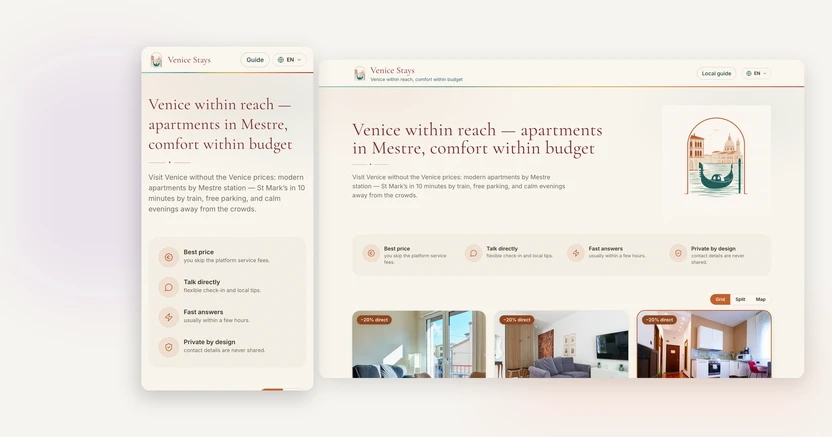
The booking platforms still have a role.
The client’s website has another one: giving the business control over how it explains itself and how the relationship with the guest develops from there.
Fix it or rebuild it?
Finding problems does not automatically mean starting again.
If the foundation is healthy, the right answer may be smaller:
- clearer content;
- better navigation;
- faster pages;
- improved mobile UX;
- better accessibility;
- a simpler form;
- one missing booking, quote or contact flow.
But there is a point where that stops being true.
If the structure no longer reflects the business, routine changes require workarounds, nobody is comfortable updating the underlying technology and every new feature has to be squeezed around old assumptions, rebuilding can genuinely be the simpler option.
The reason should not be:
"The site is five years old."
It should be:
"The current site makes something the business or its customers need unnecessarily difficult."
Before deciding, ask these ten questions
Whether you have no website, an old one or a relatively recent one:
- How do customers usually discover the business?
- What do they do after they first hear about it?
- What are they trying to verify?
- Which questions do they repeatedly ask?
- Does the current online presence answer those questions clearly?
- Does it work well on the devices customers actually use?
- Is the information current and consistent with the business today?
- Is the next useful action obvious?
- Can normal content be updated without unnecessary technical work?
- Is there something customers or staff still do manually that the website could reasonably simplify? Check what might be worth automating →
Those answers tell you much more than whether the design looks old.
They also tell you whether you need a website for the first time, need to improve the one you already have, or should leave most of it alone.
Start with what the customer needs to understand or do. Then decide what the website needs to become.
Sources
Gartner, 9 March 2026 — survey of 646 B2B buyers; 67% prefer a rep-free experience for at least part of their purchase. Gartner newsroom
6sense, 2024 European B2B Buyer Experience Report — European buyers first contacted sellers at 67.7% of the buying journey on average; the vendor leading the shortlist at first contact won 78.5% of the time. 6sense research
Contentsquare, Digital Experience Benchmark 2026 — 69.9% of web traffic came from mobile devices. Contentsquare benchmark